
Hi, I'm Bálint, MSc. Architect. I take on geometry-heavy modeling work so your team can focus on design.

BIM geometry models.
Precision models delivered into your documentation workflow.

Algorithmic precision.
Computational validators eliminating downstream site errors.

Flexible support.
Modeling capacity that scales to fluctuating project loads and deadlines.


Real-time documentation.

Concept-to-fabrication modeling.

Graph-driven axis management.

High LOD precision modeling.
Test this on a single model
Try it on a hard problem. Send over a task — like a tricky wall or a tedious facade fragment — and I will show you the approach.
balint@fuzesarch.com
+36302980503
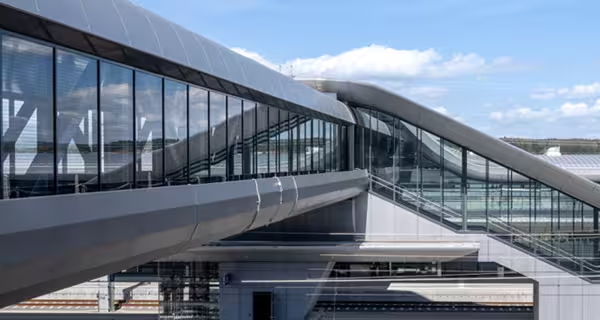
Unitized panel claddings.
Adaptive substructures.
Envelopes, roofs and shadings.
Singular sculpture items - and more.
Multi-story facade grids.
Specific building structures.
Detailed panel items.
Millimeter-precise joints.
BIM-compliant LOD 400 Revit models.
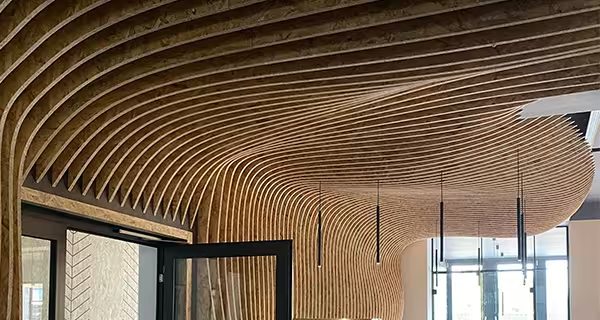
Programmatically controlled Rhino shapes.
Bidirectional ArchiCad data transfer.
Rapid drafting surges on tight deadlines.
Specific module deployments.
Multi-year project partnerships.
Try this on a no-commitment task.
You keep creative control and IP.
Programming is not your worry.
Programmatic dimension checks.
I develop reusable .NET C# components speeding up delivery across projects. They are built upon my open-source graph engine:

Bálint Füzes
MSc Architect & Software Developer
I’m Bálint Füzes, MSc Architect and certified software developer. I support architect and engineering teams with modeling and computation - usually at the construction-near phase of projects.
My focus is the harmonious interplay of geometry and algorithms - to expand work-in-progress designs into logically lightweight, yet highly-detailed, fabrication-ready models.
Architect and civil engineering teams who need geometry taken from design intent to construction-ready precision. The scale and type of structure don't matter — what matters is the task: expanding designst oward permit, fabrication and execution plans. If your team is at the point where the geometry step-by-step needs to become exact, traceable, and buildable, that's where this fits.
As a flexible back office, on-demand. You stay focused on the project itself — I look at what the geometry actually requires at that phase and we find the right setup together: fully remote, in-house, project-based, a longer partnership, or anything between. You keep full project authority, authorship, and IP. The overhead of adding this capacity is as low as it gets.
Not at all. Coding is my own background toolset — it's what guarantees dimensional and geometric validation behind every model, and what accelerates delivery across projects. Your team never touches the underlying logic. You get the output: clean, construction-ready geometry that's been checked programmatically, not just visually.
Yes, and it happens quite often as a regular part of my work. I build components that teams use in-house — document automation, viewport logic, parametric validators, project-specific solvers. The code is always built for zero coding knowledge on your end and always has documentation and prepared examples. In such cases you get nodes anchored to exactly what the workflow needs based on preliminary mindmaps I always create as an overview. They are ready to use without you needing to understand what's inside them.